Monday, August 27, 2018

SPARK!


Recently we were asked to present a 'Spark Session' at a Personalized Learning Conference in Chanhassen, MN. "Sure!" Was our response, shortly followed up with "What is that?" The response: "It's just a 5 min. inspirational speech. Just wow them with humor and inspiration. It's a pep talk!"
We were honored and also greatly challenged! Below is our original script for our 'Spark Session' (slightly over 5 min.), and the video of the end result. We loved this exercise and plan to implement something similar with learners this year! 

Spark Session
We are fellow educators who don’t take our careers for granted. Our relationship is unique because we are not only colleagues but sisters as well. Our journey to embrace and practice personalized learning has given us a new lease on careers we love.


We wish everyone had the opportunity to work with their sister because we feed off each other’s energy and creative ideas. More importantly, we give each other courage. Courage to take risks, be vulnerable...lead a ‘spark’ session. That’s one of the things we want to share with you today. In your work, you may not have the opportunity to work with your sister, but we encourage you to find your person that can be that inspiration to you.

Relationships, resources and relevance are three components of personalized learning we found to leverage the purpose of one’s learning.


Relationships and Resources
Scientists have found that our need to connect is as fundamental as our need for food and water. Our instinct for relationships and connections is why most of us became teachers. Our calling is to work with children and have a lasting impact on their lives. The research also says, that no significant learning can occur without a significant relationship. Every child that walks into our classrooms wants to be validated, and in the words of one of our favorite teachers, Oprah, every person wants to know, do you see me, do you hear me, does what I say matter to you?  


In our work we are reminded that it’s impossible to form connections with every learner if we are standing behind a desk or podium and talking at them for most of the class. Personalized learning invites us to establish deeper connections to our learners because it allows us to shine a light on their interests, talents and gifts. By inviting the learner to engage in the learning process, we have seen those quiet and reserved learners become passionate and excited to share their discoveries. For instance, we will never forget when we went away from our traditional summer reading essay and asked learners to answer the question, “How does reading create an experience for one to grow?”  At first they were hesitant in trying to respond to the teacher truly giving them creative permission. In the end, they each brought unique and creative ideas to express learning, and began to see one another in different lights. New connections were formed and they began to see one another as resources and experts.  It was apparent that the teacher was not their only learning partner in the room. Establishing meaningful relationships and honoring a learners’ voice with choice, has allowed learners to express understanding in ways we never imagined or frankly witnessed in the past.


Our mindshift brought some anxiety because often times as teacher we are afraid to “let go”. This mindset comes with positive intent. We care so much and carry a deep passion for youth and our content area. We want to ensure learners are getting everything we think they need to know. But as one teacher said, “Just because they are sitting in front of me, doesn't mean they are getting it.”  You see a learner may not have found one of our favorite quotes in Animal Farm to support her argument, but she still demonstrated creative and insightful thinking. She (like many of her fellow learners) actually exceeded our expectations. She brought things into the learning community that were out of our “how students show what they know-repertoire”. In letting go we have been able to see our learners as crucial resources in the classrooms. After all isn’t that why kids want to come to school, to collaborate and learn from others including their own peers? Once again when we shine a light as we seek them out as resources, shine a light SO BRIGHT on our learners strengths, we help build their agency to tackle some of their areas of growth. Relationships and resources are the bookends to providing relevance to a learner.  


Relevance
An author once wrote, “Boredom is a sign one loses capacity for awe, wonder and delight.” Our experience as a learners was much about compliance. We were really good at “doing school”. We could fill out a worksheet like nobody’s business, we could neatly write our names and turn in a signed syllabus on time-even early on most occasions. We were masters of extra-credit and we tried hard to find relevance in what our teachers were teaching, not because we were inspired, but because we were compliant. Although we had some great teachers, most of our education lacked any relevance or connection to us. With that came a stifling of much of the creativity and insight we had to offer.


We see this same thing happening with learners today. Take Elise, a young lady who was working on demonstrating her ability to understand rhetoric by researching a debatable topic and crafting a persuasive speech. We gave her the parameters of the assignment which mostly involved the learning target, a list of resources and a timeline. That’s it, a one page google doc with easy to access links and clean cut language that was straight to the point. After a day of brainstorming Elise came up and said “Hey Mrs. Loo, I have my topic now.” “Oh great Elise, what is it?” “I am going to argue how school’s are getting worse.” Wow, if that isn’t a kick in the gut right? I replied “Tell me more about your thinking.” “Look, I just don’t like all this choice. I just want a packet okay? Just give me a packet so I can just do the work.” I was heartbroken, frustrated and exhausted for Elise in that moment and after a brief moment of silence while I went to grab her kleenex for the huge tears rolling down her cheeks, I said, “Elise, you want to move out to LA and design your own fashion line right?” “Yes.” “Elise, do you want someone to tell you the fabric and color choices you can use in your designs? Or do you want to someone to tell you the style of clothes you should produce?” “Head shake no.” “Well then me giving you a packet for this assignment isn’t going to help you get to LA.” Our conversation evolved into her talking about topics within the fashion industry that she could debate. She chose to write a speech about how she is 100% against plastic surgery. In the end she gave a fantastic speech and inspired others to consider the message plastic surgery sends to the consumer. Her speech was outstanding and her research well founded. On her way out the door after class I stopped her and said, “See what you can do without a packet Elise?” She smiled and those tears came back, but this time they meant something different. Elise’s creativity and wonder was overshadowed by her ability to be really good at completing packets. She struggled to find a relevant topic because she was relying too heavily on a packet as a crutch to aid her thinking. When she finally found her pathway and took control of the learning, she was able to build her own agency in ways she never thought possible before. Elise isn’t the only learner who traveled her own path during that unit, all of her classmates did as well. Together we learned a lot about the art of persuasion through a diverse set of controversial topics. What’s more is that together we learned about the unique individuals who were the fabric of our learning community.


We saw each other, we heard each other and what we shared mattered. This is the outcome of a community of learners being honored and empowered in the learning process.

Tuesday, May 29, 2018

Why Don’t We Trust Learners to Make Choices?

In a personalized learning model, learners are given choices in how they prefer to access, engage and express learning. How can we trust that kids will make the right choices for their learning, is the number one question we are asked by teachers and parents. That question and the concerns that come with it, exemplifies the a big disconnect in education today.  If we are not preparing and allowing learners to have choice in their learning we are doing our kids a great disservice.  How can learners develop independence, self-confidence, and ownership if we don’t allow them to have some say in the learning process? A teacher’s role is not any less evident than in a traditional setting.  The teacher is guiding, modeling, and monitoring the learners so that they understand what choices to make and how those choices impact the learning. When the purpose is clear (connected to standards/learning targets), formative assessments are used as feedback, and reflection is ongoing, the learners can be trusted with making informed choices alongside the teacher.

A Framework that Connects Learning to the Standards
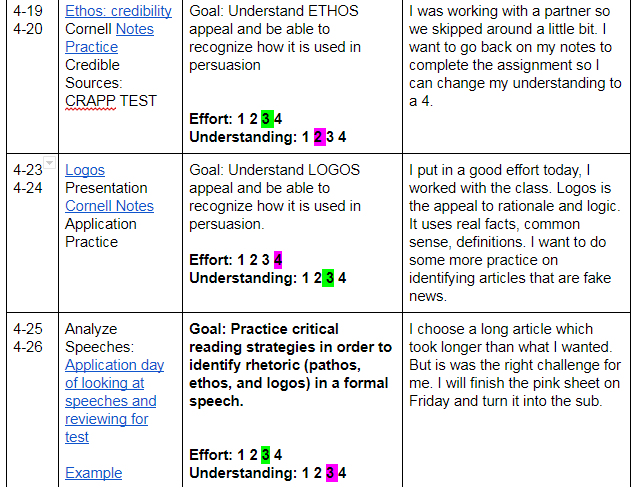
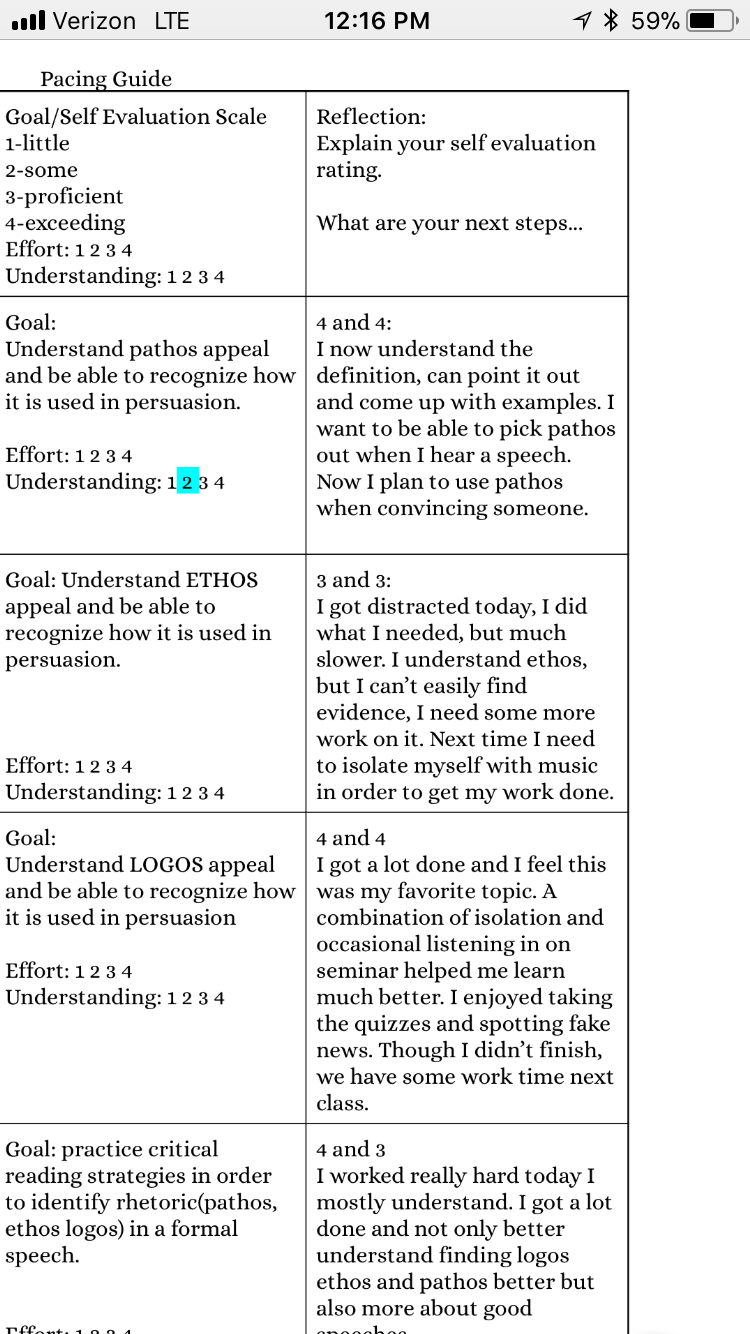
With our personalized learning framework the learners can see how all content learned prepares them for meeting a standard. We outline the standards for an entire unit for the learners, and each day we give them a goal to reach or have them set their own goal for the class (sample unit guide). The daily goals are directly connected to standards and give learners measurable data to consistently track their effort and understanding. When the purpose is clear (the why/daily learning goals) the how can vary. Learners are given voice and choice in what pathways they take in meeting the goals(see Multiple Pathways). When the time comes to express learning in a summative (final test, project, paper, etc.), the results are a much more accurate reflection of what one knows against a standard.  


Formative work as Feedback
Many teachers have shifted their assessment practices into formative and summative assessments, but have not shifted how they USE these assessments. The point value or weight of the assessments have changed so that formative work is worth a fraction of a learner’s grade.  A common misperception is that learners have stopped caring about the formative work because it “doesn’t have much impact” on their grade.  To us, it’s clear that something was lost in the messaging both for teachers and learners. Formative work is not simply daily work or small assignments that lead up to a test, rather they are an avenue to provide feedback to learners. In order for formative work to be useful it must connect back to the intended learning (the standards), inform a learner of what they know or don’t know, and have the potential to elicit an instructional response from the teacher.  We rarely give a numerical score on a piece of formative work but prefer to give a symbol instead. The plus symbol(+) means one is on pace, (+/-) directs one to closely review teacher comments, and the minus symbol (-) signals one must attend the next teacher seminar for clarification and/or more support. Learners use any of their formative work to understand what pathway to take. Pathways in our class include teacher seminar(direct instruction/guidance from the teacher), collaborative groups(processing with a group working on the same goal), or personal flex(self pacing and working independently to achieve a learning target). Daily reflection on effort and understanding as well as the symbolic teacher feedback on formative work  (+, +/-, -) help a learner make informed choices when it comes time to access and engage with materials that support learning.


Reflection for Learning
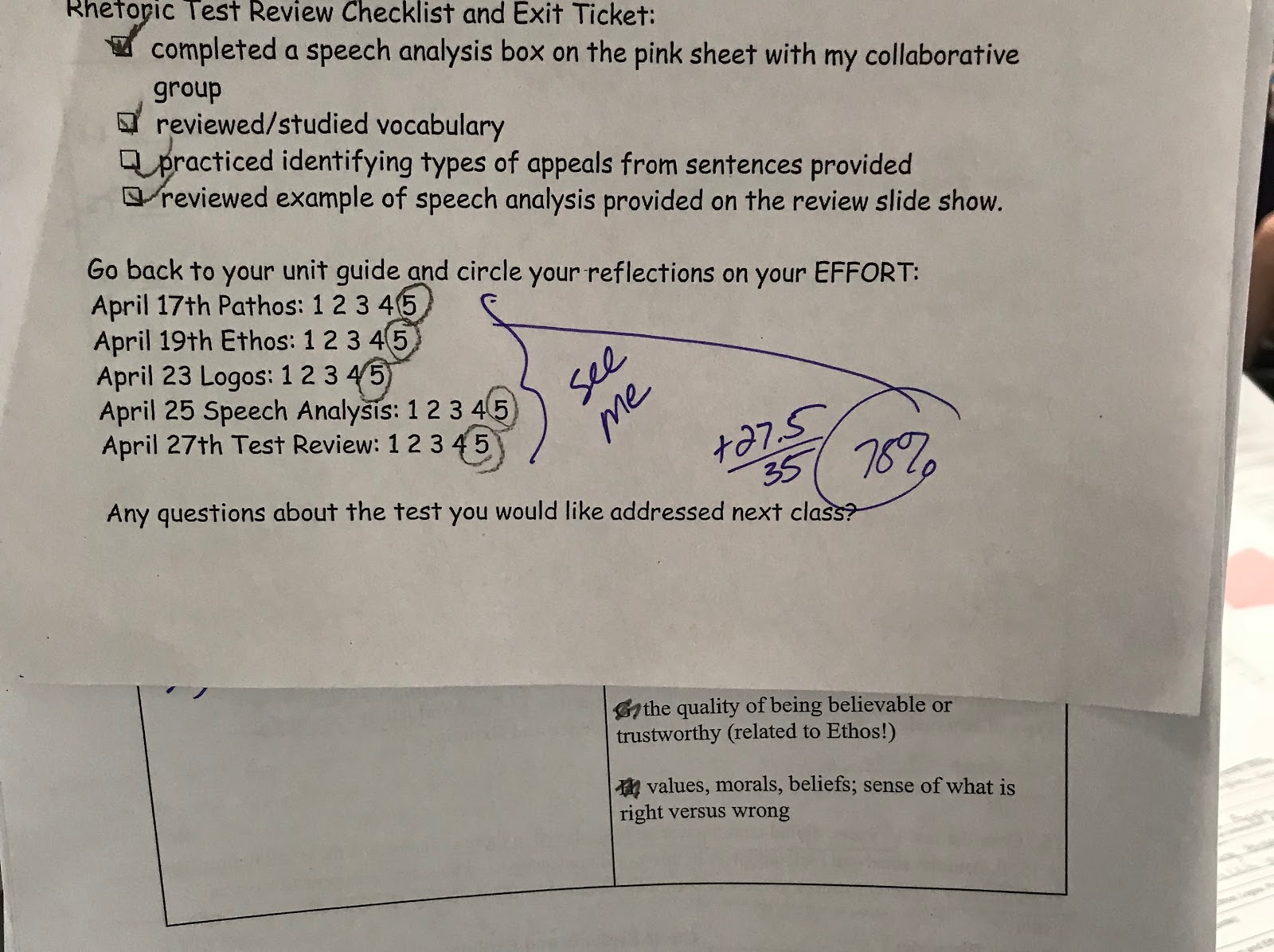
Learners are asked to reflect on themselves as a learner when they receive feedback, have a choice in their learning, and at the end of each class.  Learners understand the only time we collect their work as teacher is if it gives us an opportunity to provide information about what they know or don’t know.  An example would be an exercise where they had to apply content or concepts learned.  If the formative work is additional practice or notes, we don’t collect it.  We don’t ever grade for compliance, only learning (see Grading in a Personalized Learning Model).
As we stated, each class begins with the learners writing down a goal for the class.  This goal is the learning target given to them by the teacher, but at some point in the unit the learners are setting their own goals.  At the end of each class learners rate their effort and understanding related to meeting their goal and plan out their next steps.  Learners are prompted to think about how the choices they made in class helped them or hurt them in reaching their goal for the day.  This allows learners to track their effort and choices and connect them to their final summative  grade. 


Choice allows for Autonomy
According to Daniel Pink’s motivation theory we are driven by autonomy, purpose and mastery.  When all learning is connected to standards or a learning target, the purpose is clear.  Allowing learners to have voice and choice in the pathway they take to achieve the learning target gives them autonomy and opportunities to achieve mastery.  Involving learners in setting daily learning goals, providing feedback to learners through formative work, and incorporating daily reflections provides learners with the information they need to make the right choices in their learning.  

Friday, February 23, 2018

Multiple Pathways

"Personalized learning” can mean many different things to many different people.  It is not a noun, a “thing”, or a prescriptive binder of information for one to follow. Personalized learning is a verb, an active method of best practice that puts the learner at the center of instruction. Personalized learning is using a variety of strategies with multiple pathways designed to meet the needs of all learners. This approach is something effective teachers have always done. Below outlines how to re-think instruction and offer multiple pathways by looking through a personalized learning lens.

Common Educational Practice             vs.              Personalized Learning Process

A teacher takes a class through a variety of exercises to learn new information or skills.  The teacher controls the pace and delivery.  
Teacher provides strategies to learn new information or skills AND makes those strategies known to the learners.  Teachers guide learners through voice and choice in understanding how they access, engage and express information.  


How many times does a teacher hear, “How long does this have to be?” “How many notecards do I need?” “How many points is this worth?” These questions indicate that learners are working to meet a teacher’s expectations. While this may work for some learners, for many others it leads to misguided stress, anxiety or intense dependence on the teacher. Rethinking instruction that focuses on the learning vs compliance, invites learners to be active participants of their learning. When a teacher is more deliberate about helping the learners to make informed choices for their learning needs, the individuals own their learning. This shift puts much less emphasis on learner compliance and more emphasis on one understanding the actual learning process. One way to increase learner agency is to leverage instructional time. 


Creating Multiple Pathways

Once the standards or learning targets are determined multiple pathways for learning can be established. To begin, a consideration for how a learner can access, engage or express information is essential. In the scenarios presented, learners can access and engage information in a teacher seminar (direct instruction guided by the teacher), a collaborative group (3-4 learners working on the same task) or personal flex/independently.  Not all learners process information in the same way, and if learners know themselves as a learner they can make the choice that fits their needs(See blog on learner profile). To articulate this further we will provide examples of what this framework looks like in our class.

Lesson, 21st Century Literacy, Study of Rhetoric
Learning Target: Understand Rhetoric (Pathos Appeal).
Chronology of the lesson:


Every lesson begins with whole class instruction. We speak to the learning target(s) for the day; be able to understand pathos appeal. Next, we preview the lesson presentation BEFORE asking learners take notes. We emphasize the skill of active listening. Which means we show each slide and offer a brief explanation that speaks to learner tasks or content.  Then, we give learners a choice in how they want to further access and engage with the information.  Each learner is required to demonstrate their understanding of the concept(s) by taking notes and completing the formative work for the day. In this lesson, the formative work required one to identify different examples of pathos appeal on a worksheet we provided.


To engage with the formative work, learners can choose from three pathways:(we use flexible seating arrangements to allow for our classroom space to support the different pathways)
One-attend a teacher seminar with specific teacher guided practice on portions of the assignment.
Two-find other learners and form a collaborative group to review the presentation on their devices, take notes and complete the formative practice.  
Three-work independently (personal flex) to take notes and demonstrate understanding of the concept through completion of the formative practice.
Rather than plan to have all learners take notes during a teacher lecture from a presentation, we present three pathways. When all is said and done, we gain more time in the course, because we are no longer waiting for all learners to take notes from a presentation simultaneously. Studies show processing speeds vary, and it’s important to consider this when determining how kids will access and engage with information. Therefore, by planning for multiple pathways for note taking and learning content, individuals can work at their own pace to make for a better use of their time. At the end of the class all learners reflect by answering two questions: -what is pathos appeal and what worked well for my learning today? This process engages learners and gives them ownership in the learning process.


Learners participating in teacher seminar for accessing Noodletools


Another way to create multiple pathways is to create flex groups within a class.  After collecting data on where the learners are at from either a Google form, learner conferences and or teacher observations you can form different flex groups based on the needs of the learners. Once the groups are formed the rotate through teacher seminars where the teacher tailors the instruction for what they need while the other learners are working in collaborative groups or independently. Picture this, while researching and writing rhetorical speeches, predetermined flex groups rotated through teacher seminar to learn how to engage with tool Noodletools. As learners navigated their way through their first experience with Noodletools, the flex group seminars aided one’s ability to better focus and increased learner engagement and understanding.


Traditionally, the teacher decides what instruction to supply, but another way to offer multiple pathways is to get input from the learners for what they need.  For example, in an 8th grade LA class teachers, Anna Jankowski and Caitlin Bailey, had learners collect data on where they were at with writing (teacher comments on past assignments, peer edits/feedback and their own reflections) to write writing goals as they go into their next writing piece.  After writing goals, they used a Google form to let the teachers know what seminars they wanted offered in the next classes.  Based on the learner input, the teachers planned and offered different teacher seminars that learners had choice in what ones they would access and engage in.  


We are constantly reminding learners that they come to school to build their capacity to learn.  Our job is to prepare them to learn anything so they can go on to pursue their dreams and perhaps make a difference in the world.  The content becomes the vehicle to build skills, teacher-technology-and peers become a learners resource, and they are the drivers for building their capacity to learn.  


Thursday, February 22, 2018

The Learner Profile


There are many definitions of personalized learning. We define personalize learning as: Placing learners at the center where multiple pathways are possible to develop essential skills, and competencies. Guiding individuals to become agents of their learning through goal setting and reflecting on the learning process. An active method where educators recognize the need for flexibility around pace, content, style, skill, background knowledge, location or some other learning dimension.  


In order for learners to be placed at the center, a learner profile must be established. For years teachers have been compiling data and information on learners to guide instruction, but how much of that information drives the learning? If we want learners to be able to have voice and choice in their learning, they have to understand how it is they learn best, their strengths and weaknesses, and how to apply their skills and interests. Here in lies the importance of a learner profile.     


Learner Profile Belongs to the Learner

A learner profile must belong to the learner and the learner must understand how to interact with it in order for it to be effective. We experimented with a few different types of learner profiles and found some things that didn’t work. For example, didn’t work to have pages and pages of documents for the learners to scroll through every time they reflected or set goals. Also, it wasn't effective to use certain terms like, access, engage, express, because it confused the learners. The language needed to be more specific without feeling like there was information overload. Furthermore, it didn’t work when we initially asked basic getting to know you questions or personality type questions. While an inventory of learning styles can be helpful, we believe a more thorough learner profile, which allows for ongoing goal setting and reflection about current coursework is more useful in the long run.  

After reflecting on things that didn’t work and visiting with Andrew Easton, a PL coach from Omaha, we came up with a three/four page "Learner Profile". We will go on to explain the different pages, but the main idea is that the learner can reference and interact with one page at a time, depending on the task at hand. Once again the learner profile belongs to the learner and becomes their “road map” or “play list” used to drive their learning. Page one is an interest page, page two is a learning preference page, and page three is a data collection page. A fourth page could be a learning inventory page dedicated to learning style and personality type, or this could be a section embedded in the interest page.  


Learner Interest Page

The interest page would be referred to when learners have an opportunity to connect learning to a personal passion. This could speak to work from genius hour, a 20% Project, a Capstone project, extended learning opportunities in a maker space to create something, a product for a mentorship or internship opportunity or any choice in project that is connected to a learner’s interest. Learners continuously visit their interest page when inspired or interested in new topics. A burning question, a personal ambition or a sudden interest in exploring something new, could all be a part of the learner interest page. Learners will feel validated and engaged in the learning process when they are able to track and refer to their interests or passions, at school and on a regular basis. We allow for learners to answer an essential question anyway they wanted in our course. At first learners were hesitant to get started, but once we encouraged them to refer to one of their interests or passions, they were off and running. (See blog Personalized Learning vs Differentiation)                                                          

https://blogger.googleusercontent.com/img/b/R29vZ2xl/AVvXsEgBNYqsyCSpQeZoK3s0ov2Bsjh4ziDLFkzW473HHAK-SWaXJttkFUPGKWtbu7EMazgqz5ktQgb_UE4Yy3A9pCl228UNXLxIHNy_v5wSfEUxQT7F1j-YvYGqje9yGFUklGrZZIN9YTPRnfVb/s400/learner+profile+interest.png

Learner Preference Page (How I learn):
The learner preference page would be a tracking sheet for learners to reflect on how they prefer to learn. Within the personalized learning framework, learners have voice and choice in how they access, engage or express information. In our class we refer to these different choices as teacher seminar, direct instruction, and personal flex/independent (click on LEARNER PREFERENCE presentation link for clarification on this). Each class could have a different link on the preference page, and at the end of a class learners could make a tally next to the choice they made about their learning preference for the day as well as how the choice impacted their learning. Although the goal is to empower the learner, a teacher can go over this page periodically with a learner during a conference in order to discuss what a learner knows about how he/she learns.


How are learners expected to have voice and choice if they are not made aware of their learning process? Most teachers plan very effective lessons, but the learners are not thinking about how strategic the teacher is in helping them acquire information. For example, in many traditional classrooms, a teacher first provides direct instruction, then moves into group discussions or practice and finally a learner completes a task on their own. In the personalized learning framework, the teacher not only points out the different ways learners are accessing information, but also stops to ask learners to reflect upon which format was most beneficial to them and why. At the end of a lesson or class, learners can take out their learner profile, go to their preference page and document the impact their choice had on their learning.


We are aware that some learners will need more guidance with their decision making and learning preferences. There is always room to reflect and grow. Teachers can help learners monitor their choices by conferencing with them regularly. A learner who may have made a less effective choice in how to learn in one instance, could make a more strategic and fitting choice in the future.  We believe in providing a space for one to fail in order to set them up for a future revelation. After some period of tracking choices, a learner can reference this work and make informed decisions for when they need direct instruction, collaborative groups, or independent flex time. For example, a learner may note they need more direct instruction in Math Class, but in a Language Arts Class, they prefer collaborative groups.  Or, when the material is difficult or new information is involved, a learner may need direct instruction, whereas if the information is a review they may be more comfortable in choosing an independent flex in order to work at a faster pace. This page of the profile can evolve to be even more specific as well.  Consider this, a learner may be aware of a specific method of note taking they prefer. We have all learners experience and learn Cornell Notes, but if they can defend another style of note taking that works better for them, we allow them to use their preferred approach. Overall, a learner is thinking about and reflecting on how they learn best.

https://blogger.googleusercontent.com/img/b/R29vZ2xl/AVvXsEhr2S9w8kirxFXuk7bP0oLRtcBxJJWTyMH0Z2kt2SlZDdldlDGBS6V2xzr4RGIHaLegFvCTIcgNr4h0WnEs-ZyG2prvwlRvmQQZlcylRqqwLx0L9oorStC4USvDgalSpahw8OHO-c4zutZm/s400/preference+reflection.png


Data Collection Page
The data collection page would be an overall picture of academic progress. Again, each course could have a link for a document specific to the course standards. In our English Class, learners can link to a unit overview. The link leads to a document where learners set goals for each unit (based on standards) and reflect on them upon completion of the unit. The data collection page specific to English Class also had learners reflecting on their reading and writing processes, as well as the strategies and skills they used to analyze and grow as a learner. This page would be a great reference for advisory, homeroom teachers, or parents to monitor learner progress in school. Again, each teacher could design a data collection page that best suits their course, yet all the information is connected and easily accessible to learners without there being too much information on one document. 

https://blogger.googleusercontent.com/img/b/R29vZ2xl/AVvXsEhChKrfsdRqyBx2U9-rLLD7LPA6bJ-DLXYHnoyECRcx8uiksNhg3eANWIxh0lxATbkywLx6agFOCCzY-ovGb3OJYa2QEIu_3uVcYdbXZvQtc2r5H4MjEihXaOaqMURl9YN2shovYyODdFkv/s400/learner+profile+data+collection.png


The Importance of Reflection


Our job as educators is to expose kids to a variety of learning experiences with an emphasis on the learning process. When learners reflect each day not only on what they learn, but how they learn, they can begin to have more ownership and recognize themselves as active participants in their education. Reflection doesn't happen naturally for all learners. Educators need to model, practice, and provide feedback for reflection. Our learner profile allows for ongoing reflection while building one's capacity to learn. 

https://lh5.googleusercontent.com/uJrh9XoVZH8BbG1iO5ncNvrrZ3PEamCRzVXekRoFbma5stFd0gsCqZdMxqujvoNXoeTHbyeD3e80vOX5fXmpGVuiO2AmYJi73QjNA_gBmRuPaaVOEk_J4YFT94tGTCGRRasigVYW


Systems and Supports for Personalized Learning: Daily Flex Time

Our school has made huge strides in continuous improvement. When we reflect on how that growth occurred it has to do with two things: syst...